
GTT Perspective · Mola Mola
An archival grade phono stage.
Lupe began as a planned RIAA module for the Makua preamplifier and became a standalone phono stage with fully independent moving-magnet and moving-coil inputs, published noise and RIAA-conformance figures, and every setting under software control.
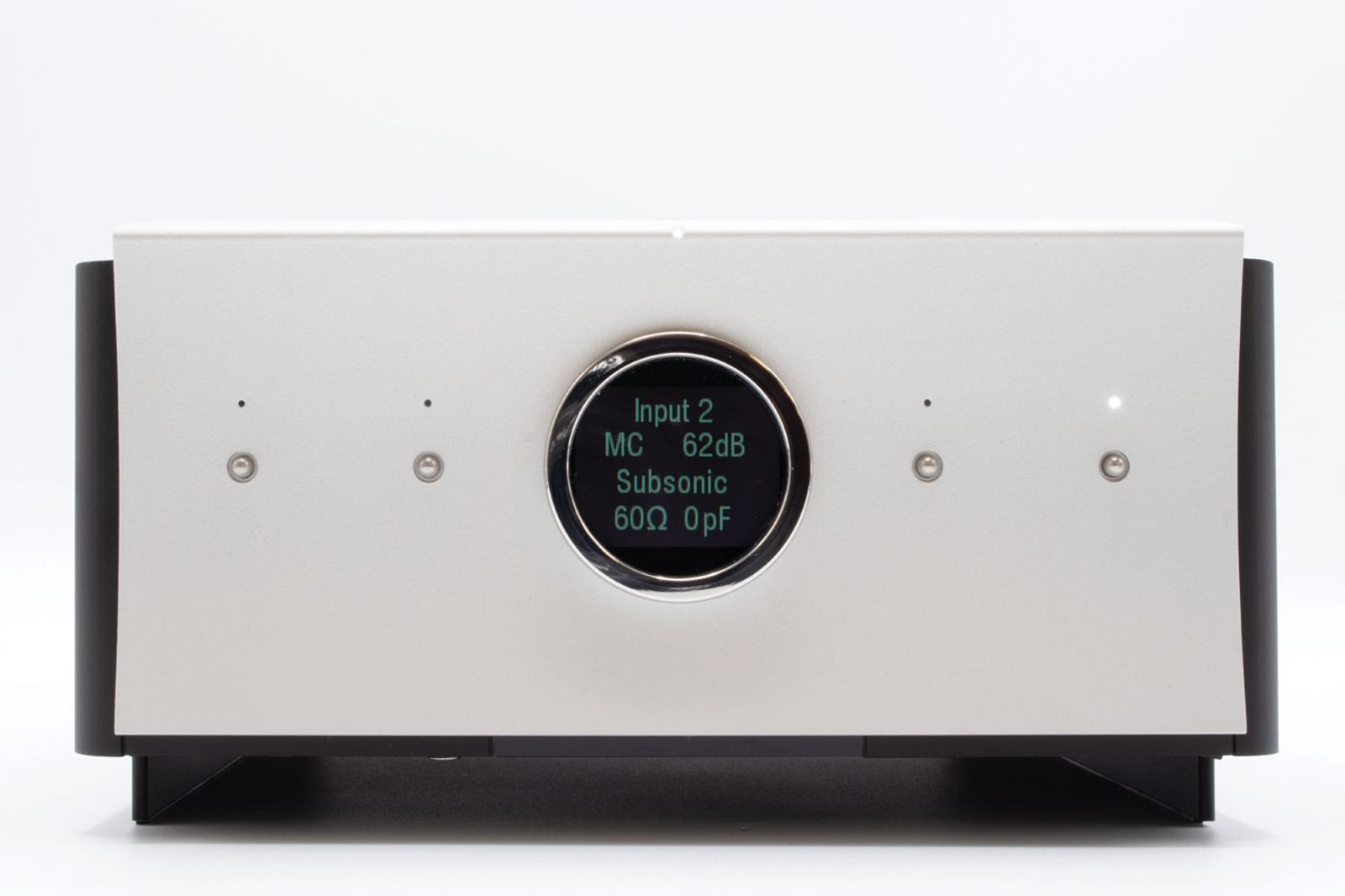
Why we distribute Mola Mola
A phono stage takes the smallest signal in the system and amplifies it; Lupe was engineered as if the record collection mattered. Its moving-magnet and moving-coil stages are fully independent, each optimized for its own noise problem, and its switching is done in the analog domain even though every parameter is set from the app.
What that buys you is quiet — a published MC input noise of 0.35 nV/√Hz — and flexibility that serves the music. Three single-ended inputs and one balanced, any of them routable through the phono stage, means multiple arms and cartridges live in one system, each on its own terms. Practically every known cutting curve is on board, including 78 RPM, so an archive-grade pressing and a modern reissue each get their own equalization.
Lupe is made for demanding analog front ends — multiple arms, low-output cartridges, archival pressings — which is exactly the context we listen in.
What the engineering actually does
Independent MM and MC stages
Rather than an MC head amplifier feeding an MM stage, Lupe gives each its own optimized input — the MM stage designed for voltage noise, the MC stage for current noise, with an equally short signal path for both. Cartridges are loaded individually, resistance and capacitance switchable per input.
Silence, specified
Published input noise is 0.35 nV/√Hz on the MC input and 0.9 pA/√Hz on MM, with RIAA conformance within ±0.1 dB and distortion specified as not measurable. Gain is switchable in 5 dB steps across 40 dB — 45/50 dB on MM, 52–87 dB on MC — accommodating cartridges from 30 µV to 5 mV.
Every curve, app-controlled, analog-switched
EQ presets cover practically all known cutting curves including 78 RPM, with selectable time constants, bass shelf, and a subsonic filter. Every setting is software-controllable from the Mola Mola Remote app — but all switching happens in the analog domain, with presets recallable from the front panel.
The conversation, in our Private Listening Room

From the independent record
- Review“This is a powerfully musical and flexible component, one that has the chops.” — Greg Weaver, Part-Time AudiophileIndependent review. Review photography by Greg Weaver.
- Review“The Lupe’s extremely low noise floor gives a vibrancy and openness to all forms of music.” — Kevin Fiske, The EarIndependent review.
- Review“I can’t recall any phono stage that extracted more music from it than the Lupe.” — Michael Trei, StereophileQuoted from GTT’s press record; original at stereophile.com
- Video“I am seriously, seriously impressed with the Mola Mola Lupe.” — Danny Kaey, SonicFlare
Questions we hear in the listening room
How many tonearms and cartridges can Lupe handle?
Three single-ended inputs and one balanced, any of them routable through the phono stage, with loading set individually per input. In a multiple-arm Kronos system each arm and cartridge gets its own optimized settings, recalled from the front panel or the app.
Does it handle 78s and non-RIAA pressings?
Yes. Its EQ presets cover practically all known cutting curves, including 78 RPM, with selectable time constants and bass shelf. For a collection that spans eras, each record is played back on its own terms.
Why does app control matter in an analog component?
Because the settings that define phono playback — gain, loading, curve, subsonic filter — are exactly the ones you adjust per record and per cartridge. Lupe keeps every adjustment in the analog domain while making it recallable, so the app serves the signal path rather than intruding on it.
Further reading
Private Audition
Give the record its own terms
GTT is the North American distributor for Mola Mola. Lupe is heard where it belongs — in a complete analog system, with the arms and cartridges it will actually serve — by Private Audition in our Private Listening Room in Long Valley, New Jersey.