
GTT Perspective · Mola Mola
Digital that stands alone.
Tambaqui is Mola Mola’s answer to a question every serious digital front end eventually asks: what happens when the converter stops imposing a character of its own.
Why we distribute Mola Mola
Tambaqui’s conversion is discrete from start to finish — an architecture Mola Mola engineered itself rather than a ready-made DAC chip — and it is a digital source we place at the center of our own reference systems.
What convinces people is rarely the first minute. It is the thirtieth. The presentation is free of strain, so you stop auditing it and start listening to the record. Detail is simply there, unforced. In our listening that is what Mola Mola’s published architecture — the discrete conversion, the noise shaping, the clocking — adds up to.
Its lossless digital volume control and headphone outputs let it serve as the entire control center of a minimalist system, or as the source feeding a full preamplifier — both ways are part of a Private Audition.
What the engineering actually does
Conversion done the hard way
Every incoming signal is upsampled to 3.125 MHz at 32 bits and converted to a noise-shaped PWM waveform, then reconstructed by two mono 32-stage discrete FIR DACs with single-stage, 4th-order filtering I/V converters. Mola Mola engineered the conversion itself rather than building around a ready-made chip, so the architecture is defined by published noise, jitter, and linearity targets.
Noise and jitter pushed out of the audible band
A 7th-order noise shaper clears the band to 80 kHz, and each incoming sample rate gets its own optimized upsampling filter chain. Published figures: 130 dB signal-to-noise, bandwidth to 80 kHz, and jitter under 1 picosecond from 10 Hz. Distortion is specified as not measurable, estimated at −140 dB.
A hub, not just a converter
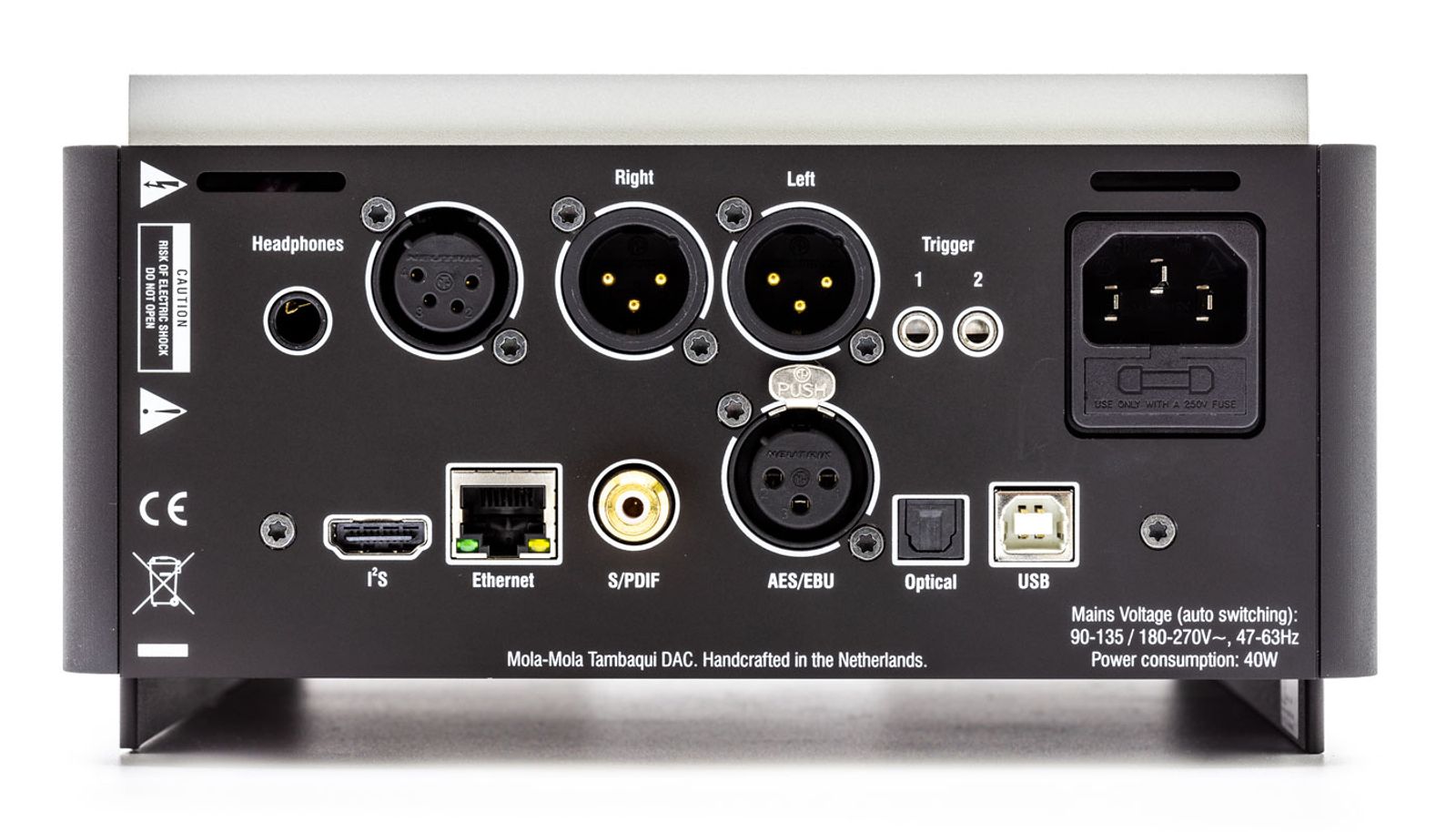
Roon Ready certification, Ethernet, USB, AES/EBU, S/PDIF, Toslink, I²S over HDMI, and Bluetooth; balanced outputs, two headphone outputs, four programmable presets, and a lossless digital volume control that lets Tambaqui drive a power amplifier directly. Rates beyond 192 kHz/24-bit are available via USB and Roon.
Our introduction, in our Private Listening Room

From the independent record
- Review“It is among the most engaging and full-bodied DACs I’ve had the pleasure to live with.” — Michael Lavorgna, Twittering MachinesLong-term independent review.
- Review“The one thing I heard from the Tambaqui that I didn’t from those other DACs was utter ease and naturalness of sound.” — Hans Wetzel, SoundStage! UltraIndependent review, October 2020.
- Review“The Mola Mola Tambaqui DAC is an absolutely extraordinary, top-o'-the-heap product, true reference-grade in every way.” — Dr. David Robinson, Positive Feedback
- Video“It sounds fantastic. It makes you want to sit and listen to music for hours.” — Robert Taylor, The Absolute Sound
Questions we hear in the listening room
Can the Tambaqui replace my preamplifier?
Where the system architecture allows it, yes — its lossless digital volume control and selectable output levels let it drive a power amplifier directly, and it carries two headphone outputs. Where a system needs multiple analog inputs or the particular character of a reference preamplifier, Tambaqui works equally well as a pure source. Both are part of a Private Audition.
What does Tambaqui ask of the system around it?
A resolving chain and a considered room — Tambaqui’s presentation is unforced enough that the amplification, loudspeakers, and setup decide the character of the result. That is exactly the context a Private Audition is arranged to provide.
Does it handle high-resolution and DSD files?
Yes — PCM to 384 kHz/32-bit and DSD to quad speed, with rates beyond 192 kHz/24-bit delivered over USB and Roon. It is Roon Ready certified.
Further reading
- GTT PressTambaqui — The Absolute Sound (Tom Martin, Best DACs)
- GTT PressTambaqui — Twittering Machines
- GTT PressTambaqui — Positive Feedback
- GTT PressTambaqui — pt.audio
- ReferenceDigital Playback & DACs
- PortfolioThe Mola Mola Portfolio
- GTT PressTambaqui — 6moons
- GTT PressTambaqui — Amplify Audio Reviews
- GTT PressTambaqui — The Audio Analyst
- GTT PressTambaqui — AVshowreports
- GTT PressTambaqui — Enjoy the Music
- GTT PressTambaqui — Positive Feedback (Robinson)
- GTT PressTambaqui — The Absolute Sound (Taylor)
- GTT PressTambaqui and Lupe — TONEAudio
Private Audition
Hear Tambaqui in context
GTT is the North American distributor for Mola Mola. The demonstration that matters is the one in a complete reference system — a Private Audition in our Private Listening Room in Long Valley, New Jersey.