GTT Perspective · Master Fidelity
Timing, treated as part of the signal.
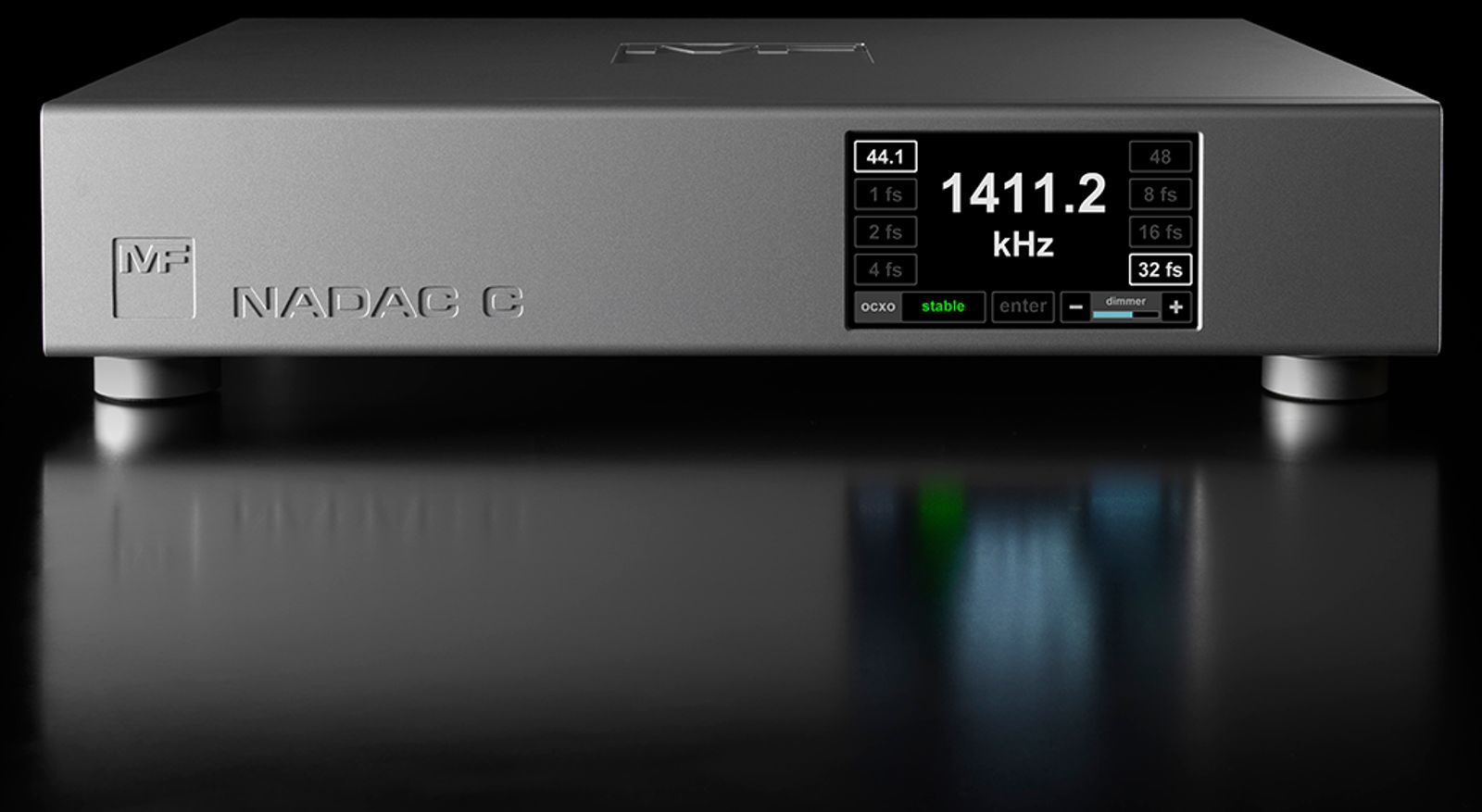
The NADAC C gives the Master Fidelity digital system a stable 10 MHz reference — controlling the time domain before NADAC D’s internal clock-recovery architecture generates the final conversion clocks.
Why the reference clock matters
Digital data can arrive intact while the timing reference around it still carries short-term instability and longer-term drift. The NADAC C addresses that time domain directly, giving compatible digital components a low-noise 10 MHz reference from which their working clocks can be derived.
That distinction matters: the NADAC C does not directly clock the converter. NADAC D’s internal Advanced Clock Data Recovery system uses the external reference as a stable foundation, then aligns its clock domains and generates the exact clocks required for conversion. Master Fidelity treats the reference, recovery architecture, power, and converter as one coordinated system.
GTT represents Master Fidelity throughout North America because this is system-level digital engineering we can demonstrate. In a resolving system, the question is not whether one clock specification looks impressive in isolation; it is whether source, reference, conversion, and analog delivery work together with musical continuity.
What the NADAC C actually does
An aged, temperature-controlled reference
Master Fidelity selects a high-stability SC-cut crystal, pre-ages it for at least 120 days before assembly, and ages it again afterward. A constant-temperature system then holds the oscillator’s operating environment stable.
Low-noise 10 MHz distribution
The 10 MHz reference is specified at 66 femtoseconds typical output jitter over a 10 Hz–100 kHz bandwidth, with factory frequency accuracy below 10 parts per billion. Separate low-noise power and distribution stages are designed to preserve that reference across the outputs.
One reference, several clock domains
Because 10 MHz is not an integer multiple of audio sample rates, the NADAC C uses separate multi-stage synthesis for word clock. It provides five 10 MHz outputs, two word-clock outputs, and a 625 kHz output for legacy Merging+NADAC use.
The people behind the time domain

From the independent record
- InterviewA GTT conversation with Master Fidelity and the Spirit of Turtle recording engineer.
- Review“The Master Fidelity NADAC C and D sound just like a master tape.” — Marc Phillips, pt.AUDIO
- Video“The NADAC pair provided the most realistic, natural, and lifelike sound I’ve ever heard from digital components in my system.” — Robert Taylor, The Absolute Sound
- ReviewAn independent examination of the NADAC clock and converter architecture.
Questions we hear in the listening room
Does the NADAC C directly clock the converter?
No. Its 10 MHz output supplies the reference foundation. NADAC D’s internal Advanced Clock Data Recovery system then removes residual timing error, aligns clock domains, and generates the final clocks used by the converter.
Are frequency accuracy and jitter the same thing?
No. Frequency accuracy describes long-term deviation from the nominal frequency; jitter describes short-term timing instability. Phase noise is the frequency-domain view of that short-term behavior, which is why meaningful jitter figures need a stated measurement bandwidth.
What can the NADAC C connect to?
It provides 10 MHz reference, word-clock, and 625 kHz legacy outputs for compatible equipment. Connection standards and impedance still have to match the receiving component; GTT confirms compatibility as part of system design.
How do I hear it at GTT?
As part of the complete Master Fidelity digital front end in our Private Listening Room in Long Valley, New Jersey. A Private Audition is arranged so the clock, converter, source, and the rest of the system can be evaluated together.
Further reading
- ManufacturerNADAC C product page
- ManufacturerNADAC C user manual
- Technical paperClock jitter definitions
- Technical paperClock jitter, noise, and distortion
- Technical paperNADAC C phase-noise comparison
- GTT PerspectiveNADAC D true 1-bit converter
- GTT PressNADAC C and D — hi-fi+
- GTT PressNADAC Digital Suite — Positive Feedback
- PortfolioThe Master Fidelity portfolio
- ReferenceDigital playback and DACs
Private Audition
Hear the complete NADAC time domain
GTT is the North American distributor for Master Fidelity. The NADAC C is auditioned with the NADAC D and the complete digital source in our Private Listening Room in Long Valley, New Jersey.